

Robotic Solar Mowers from EPCOT 94!
In the Volume 1, Issue 1 of EPCOT ’94 Insider (September 11, 1994), there’s a blurb about the incredible robotic solar mowers!

See The Incredible Poulan / Weed Eater Robotic Solar Mowers.
You’ll never look at yardwork the same way again!Demonstrations daily until dusk near Inventions Plaza (weather permitting).
As someone who has been regularly cutting grass since I was 11, this is technology that would have inspired and intrigued me.
Doing some research on the web, I ran across very little information about this cutting edge (pun intended) 1994 technology.
I ran across a 1994 Wired article that waxed poetically about this $1,995 robotic mower.
Looking like an oversized solar-powered horseshoe crab, the 12.5-pound mower runs continuously on 34 solar cells, nibbling away at any lawn throughout the day. It has an on-board computer and guidance system that keeps it on course. A safety cut-off and a buried yard perimeter wire prevent the mower from going berserk, tearing off through the neighborhood and running over the poodle next door.
Since I first wrote this post, I’ve done a lot more digging. It turns out the little green machine that was buzzing around Future World in 1994 has a much bigger story than one blurb in a park newsletter. It was one of the very first robotic lawn mowers ever sold to the public, and EPCOT guests got a sneak peek at it before most of America even knew it existed.
What Were the Robotic Solar Mowers at EPCOT ’94?
The mowers on display were the Weed Eater Robotic Solar Mower, sold in the United States by Poulan/Weed Eater of Shreveport, Louisiana. If that name sounds familiar, it should. Weed Eater was the company that made string trimmers a household item, and by the 1990s it was part of the same corporate family as Husqvarna, which was owned at the time by the Swedish appliance giant AB Electrolux.
That family connection is the key to the whole story. The robotic mower EPCOT guests watched was essentially the American version of a machine Husqvarna was preparing to launch in Europe as the Husqvarna Solar Mower. The two companies shared the design, and Weed Eater handled the North American market.
In other words, the “Poulan / Weed Eater” mower in the EPCOT ’94 Insider was the same basic machine that Husqvarna still celebrates today as the world’s first commercial robotic lawn mower.
A Belgian Inventor and a Swedish Turtle
The robotic solar mower didn’t start in Sweden or Louisiana. It started in Belgium with an inventor named André Colens.
Colens came up with a mower that could cut grass using about 40 watts of power, a tiny fraction of the three or four horsepower that conventional wisdom said a mower needed. He patented his solar mower design in the early 1990s and licensed it to Husqvarna. The idea was that you didn’t need a big, loud engine if the mower never stopped working. Instead of hacking down tall grass once a week, it would nibble a little bit every day, like a grazing sheep.
Husqvarna’s CEO at the time, Bengt Andersson, saw the potential and put together a small team of engineers around 1992 to turn the prototype into a real product. According to the team’s own recollections, not everyone was a believer at first. At least one engineer looked at the early mower and dismissed it as a plastic toy that would never amount to anything.
By 1994 the mower was ready to start showing off for the press, which lines up perfectly with its appearance at EPCOT that fall. Husqvarna officially launched the Solar Mower in 1995. Because of its rounded, low shell and slow, steady pace, it picked up a nickname that stuck: “the turtle.” (Wired went with horseshoe crab, but I think we can all agree it was some kind of shelled critter.)
Colens didn’t stop there, either. He went on to develop more autonomous machines, including battery-powered mowers and robotic vacuums, and later founded Belrobotics, which still builds professional robotic mowers.
How the Robotic Solar Mower Worked
For a gadget from the same year as the first Sony PlayStation in Japan, the robotic solar mower was surprisingly clever. Here’s what I was able to piece together from articles published in 1994 and 1995:
- Sun-powered blades: A bank of solar cells across the top of the shell (34 of them, according to Wired) powered both the drive wheels and the cutting blades. No gas, no oil, no extension cord.
- Tungsten blades: The mower used tungsten blades to trim the grass a little at a time.
- Slow and steady: Its top speed was about 1.5 feet per second, which is roughly the pace of a leisurely stroll through World Showcase on a hot August afternoon.
- Random roaming: Instead of mowing in neat stripes, it wandered the lawn, bounced off obstacles like trees, hedges, and buildings, and then headed off in a new direction looking for uncut grass.
- Perimeter wire: In yards without a natural edge, owners buried a perimeter wire that sent a signal telling the mower to turn around. That’s the same basic approach most robotic mowers used for the next 25 years.
- Smart shutoffs: It sensed the height of the grass, shut itself down when the lawn was too wet to cut, and even sounded an alarm if someone tried to walk off with it.
- Lawn size: It could handle an area of up to about 13,500 square feet and even climb small hills.
The best part was the maintenance schedule. You set it on the lawn in the spring and picked it up in the fall. That’s it. For a kid who had been pushing a gas mower around the yard since he was 11, that sounds like something straight out of Horizons.
Weed Eater Brings the Mower to America (and to EPCOT)
In early 1994, the farm and rural equipment magazine FARM SHOW reported that Poulan/Weed Eater planned to bring the Belgian robot mower to the U.S. and Canada. The company expected to have a limited number of units available in 1994, with wider availability in 1995 “if all goes well.” In Europe, the mower was already selling for around $3,000, and Weed Eater hoped to bring the price down for American buyers. The company also planned to make some engineering changes to adapt it to North American lawns.
By the time it reached American shoppers, the price had settled right around $2,000, which matches the $1,995 figure in the Wired article. It was also sold through Real Goods, the eco-friendly catalog company that specialized in solar gadgets.
To put that price in perspective, $2,000 in 1994 could buy you a very nice riding mower, or a whole lot of Disney World vacation. In March 1994, a one-day ticket to EPCOT went up to $36. Spending two grand on a lawn mower that moved at a crawl and cut a little at a time was a big leap of faith for any homeowner, which is exactly why a live demonstration mattered so much. It’s one thing to read about a robot mower in a magazine. It’s another to stand on the edge of the lawn and watch it work.
So where do you show off the lawn mower of the future to millions of people at once? EPCOT, of course. A daily demonstration in Future World put the mower in front of exactly the kind of audience that would be excited by robots, solar power, and a world without Saturday morning yardwork. It also gave Weed Eater a perfect stage just a few months before the mower hit the wider market.
Finding the Mower Demo at Innoventions
Included in the EPCOT ’94 Insider was a handy-dandy map of Inventions, which outlines all of the different sponsors and displays.

In the close-up version of the map below, you can see that the area for the robotic solar mower display would be behind where Project Tomorrow: Inventing the Wonders of the Future area was.

Some context helps here. 1994 was a year of big changes at EPCOT. The park had dropped “Center” from its name and was now officially EPCOT ’94 (it would become EPCOT ’95 the following year before settling on just Epcot in 1996). CommuniCore, the original hub of Future World, closed in January 1994, and its two buildings reopened that summer as Innoventions. Where CommuniCore was calm and educational, Innoventions was loud, bright, and packed with sponsor showcases for the latest consumer technology, from video games to home electronics.
A solar-powered robot mower fit right in with that new attitude. It was exactly the kind of “this is coming to your house soon” product that Innoventions was built to show off. And since it needed real sunshine and real grass to work, it makes sense that the demo was outside near the plaza rather than tucked inside one of the buildings.
Why EPCOT Was the Perfect Stage
When you think about it, the robotic solar mower was a very EPCOT product. The park opened in 1982 with a promise to show guests the technologies that would shape their future, and so many of those ideas centered on everyday life. Horizons showed us robotic farm harvesters and automated homes. The Land showed us new ways to grow food. Universe of Energy talked about solar power and where our electricity would come from.
The robotic solar mower combined all of those themes into one little green shell. It was a robot, it ran on the sun, and it handled a chore just about every suburban family in America knew well. It wasn’t a flying car or a space colony, but it was a real piece of that promised future that you could actually buy.
It’s also a reminder of how many sponsor displays came and went at EPCOT without much documentation. Big attractions get books, documentaries, and ride-through videos. A daily lawn mower demo near a plaza? That lives on mostly in park newsletters, guide maps, and guests’ home videos.
Whatever Happened to the Robotic Solar Mower?
The robotic solar mower wasn’t a runaway hit at first. It was expensive, early units needed plenty of servicing, and a lot of retailers didn’t quite know what to make of it. But the people who bought one tended to love it. That loyal response convinced Husqvarna to keep going.
In 1998, Husqvarna introduced the Solar Hybrid, the first generation of what would become the Husqvarna Automower. It added a rechargeable battery and a charging station the mower could return to on its own. That was the big leap that turned the robotic mower from a novelty into a practical product, and the Automower line has been growing ever since. Husqvarna eventually built hundreds of thousands, and then more than a million, robotic mowers. Today’s models connect to smartphone apps, use GPS, and in some cases don’t need a perimeter wire at all.
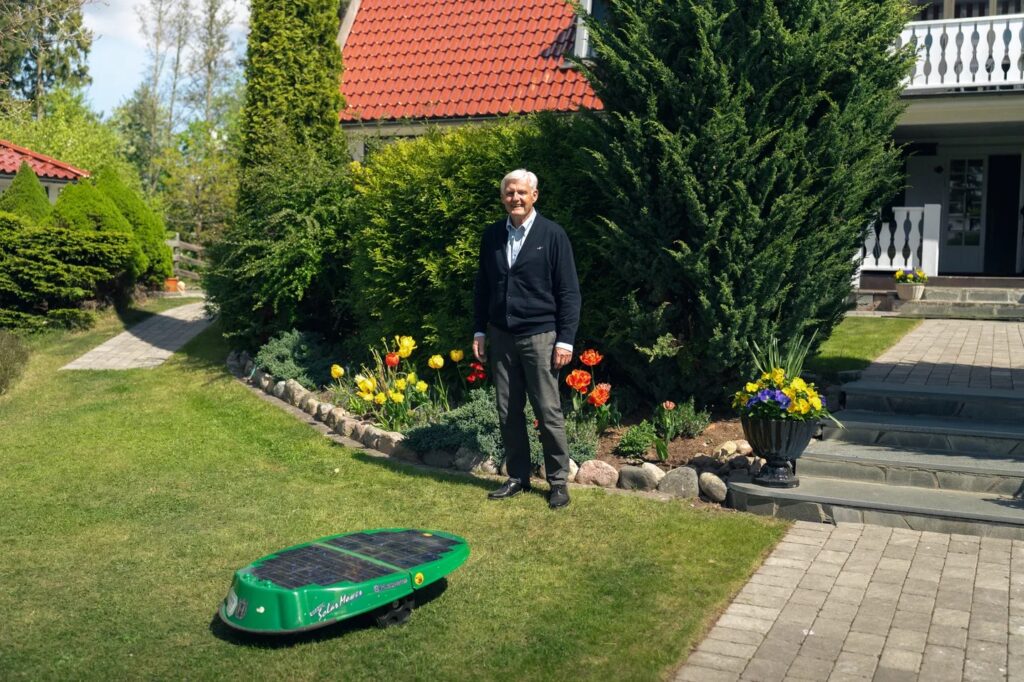
And some of those original solar “turtles” are still out there. To celebrate 30 years of robotic mowing in 2025, Husqvarna held a contest to find the oldest of its robotic mowers still in use. The winner was a 1995 Solar Mower in Motala, Sweden, which was still cutting grass three decades later.
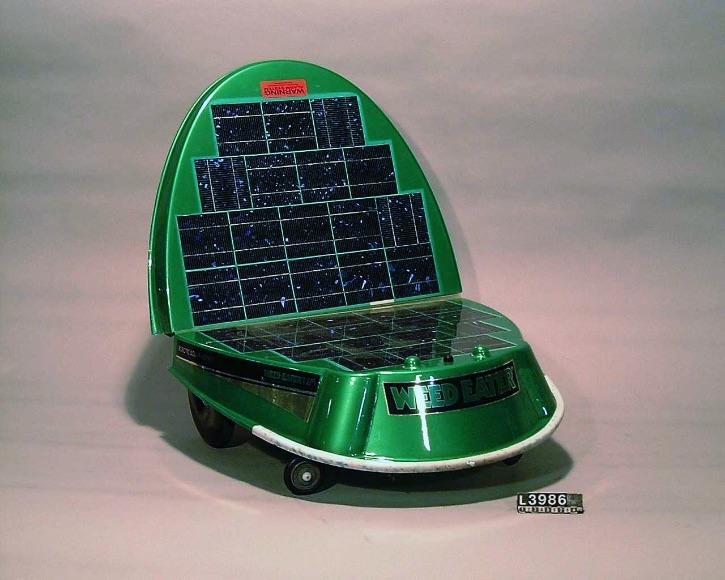
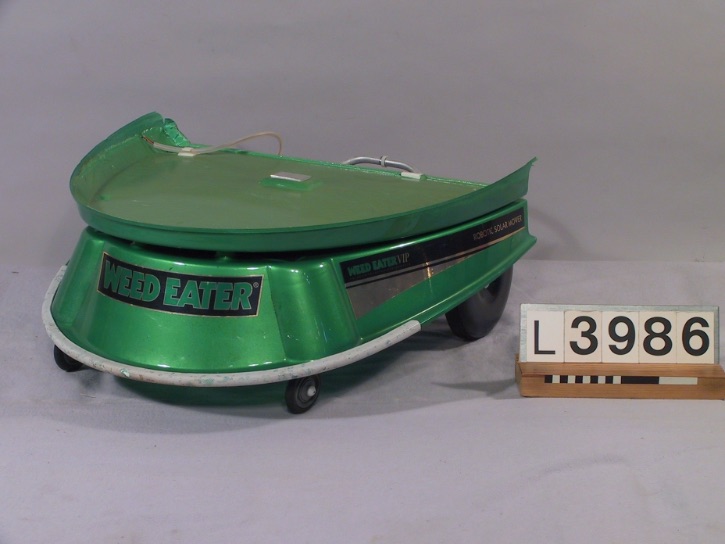
There’s also one preserved in a museum. Tekniska museet, the national museum of science and technology in Stockholm, has a Weed Eater robotic solar mower in its collection. It was donated by AB Electrolux in 1999, made in the USA, and is catalogued as a “Weed Eater VIP.” The museum notes that the same mower was also sold as the Husqvarna Solar Mower. That’s about as close as you can get to seeing a twin of the EPCOT ’94 demo mower today.
Did You See the Robotic Solar Mower at EPCOT?
It’s funny to think that one of the earliest robotic lawn mowers in America was quietly cutting grass in Future World while most guests walked right past it on their way to Test Track’s predecessor, World of Motion, or the brand new Innoventions buildings. Today, robotic mowers are a common sight in neighborhoods all over the world. Back in 1994, EPCOT guests were among the first to see one in action.
Check out this great book on EPCOT Center:
I have footage!