
EPCOT Shapes up!
In the early 1980s, one question followed Disney everywhere: Where is EPCOT? For years, Walt and Roy Disney had promised a bold vision called the Experimental Prototype Community of Tomorrow. But by the mid-1970s, critics, journalists, and even Disney fans were wondering if EPCOT would ever truly materialize. Then something remarkable began to happen. Construction accelerated, new pavilions rose from the Florida soil, and newspaper photos finally showed what many had been waiting for. EPCOT Shapes Up became more than a headline. It became proof that Walt’s ambitious idea was finally becoming reality.
In a previous post, I discussed Card Walker’s statement from 1976 about EPCOT Center. In explaining how the company proceeded with Walt’s plans for EPCOT Center after his passing, then-Disney President Card Walker stated:
“The first phase has been the recreational community,” he said. “The Magic Kingdom, the hotels and lakes and campgrounds. Now we are launching the second phase of Walt’s idea: the scientific, industrial, communication, world co-operation aspects of EPCOT.” — Spring 1976 Disney News
Basically, Disney tried to showcase that all of the behind-the-scenes technology and advancements that already existed in the Walt Disney World Resort were Walt’s vision for EPCOT. From the automated trash disposal, central energy plant, fiber optic telecommunications, the sewage treatment, and more, Disney was proud to tout all of the technological achievements of the Florida project. But it still wasn’t enough to quell the EPCOT hungry masses.
From a 1981 Sentinel Star article:
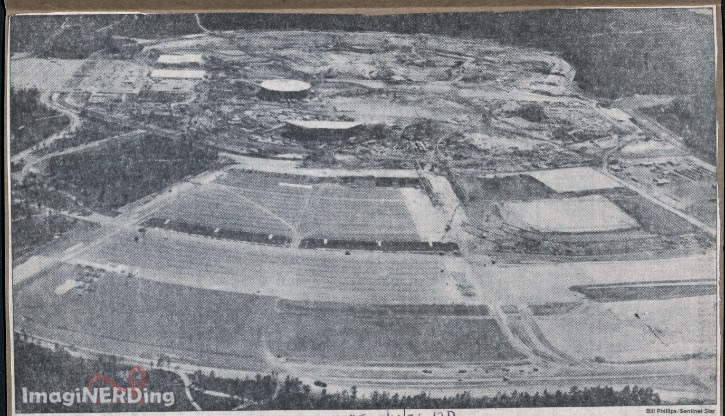
EPCOT Center, Walt Disney World’s $800 million project that will become a part of the Experimental Prototype Community of Tomorrow, is rapidly taking shape. The fan-shaped parking lot in the foreground will accommodate 6,000 guests’ vehicles when the attraction opens in October 1982. The wedge-shaped building at the front of the parking lot is to be “The Universe of Energy,” with Exxon Corp. as the participant. The circular building behind it is Transarama 2000, with General Motors as the participating company. Eighteen American and foreign firms will sponsor pavilions in the park. The flat-topped buildings at the upper left are service structures.
Looking back at articles like this, it is fascinating to see the moment when EPCOT Center stopped being a promise and started becoming a place. Early names like Transarama 2000, construction photos, and glimpses of unfinished pavilions captured the excitement of a park that would open in October 1982 and change Disney history forever. If you enjoy exploring these early EPCOT stories, you will love the book I recommend below, which dives deep into the design, construction, and ideas behind the park.
And I would love to hear from you. Do you remember seeing early EPCOT construction photos or reading about the park before it opened? Share your memories and thoughts in the comments.
Imagine being a young child and seeing this glimpse of the future in your local paper.